

This morning our class visited the Bargello Museum with our "guide" Joan Reifnsyder. It is an incredible museum, often overlooked by many tourists.

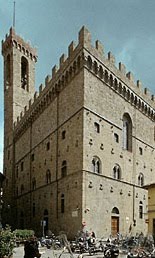
Built in the late 1200's, it is one of the oldest public buildings in Florence and eventually became a meeting place for the city council (a guild of merchants). The merchants' power was, however, severely limited by their lack of a military for they were not nobility afterall. For protection, they would hire a knight from outside of Florence. Bargello actually means Captain of Justice and the influence of these "captains" can be seen in their coats of arms lining the interior wall of of the courtyard. By 1574 the building served as a jail and many of the rooms still show evidence of where the cells used to divide the space.
By the mid 1800's, the Bargello became the first national museum as Italy united and Florence was the Capital for a short 5 year stint. At that time it was completely restored, vaults painted etc. and the building appears now as it was completed then. It is primarily a sculpture museum, housing important works by Ghiberti, Brunelleschi, Donatello, and Michelangelo (all of whom are considered Renaissance artists). I name these artists, specifically, because their sculptures are so much better understood within their cultural context.
I, for one, am not a fan of gilded allegorical works. If I had been in the Bargello by myself I would have flown by these two "Sacrifice of Isaac"s without a second thought. But they both play an important role in Florentine architecture and provide interesting insights into newly emerging Renaissance tastes.


In 1401 there was a competition to commission an artist to design the doors on the northern entrance to the Florence Baptistry. Several artists competed, all adhering to the same parameters of design (Isaac and Jacob, an angel, a symbolic lamb, a donkey and two shepherds) but only the 1st and 2nd place pieces were saved... the rest were melted down for the bronze to be used in the actual making of the doors... a classic example of how art was actually created in the Renaissance: by commission only. Artists didn't create a piece of art and then try to sell it, like now. Every artist knew exactly where the money was coming from before they started any work of art.
Ghiberti's design won the competition. But why was it chosen over over Brunelleschi's? It all comes down to composition and the depiction of emotion. Ghiberti's design is classically Greek, with the contraposto (weight on one leg with lowered opposite shoulder) pose of Isaac and the beautiful angular structure of the figures, where the eye is led from the symbolic lamb in the upper left, down through Abraham's upraised arm and then perfectly supported at the bottom by the donkey and shepherds. The figures are calm and contained within their borders. Brunelleschi's in much more violent. Abraham is already plunging the knife into Isaac's throat (so much so that the Angel has to actually physically restrain his hand) and the look of torture and anguish on both Isaac and Abraham's face is palpable. The bottom figures seem to be bursting from their borders rather than maintaining a supportive calm. This is the direction the Renaissance will eventually head (Caravaggio immediately comes to my mind) but Florentine tastes are not there yet. They are looking to the ancient Greeks for their aesthetics and so Ghiberti wins because his design is perfectly aligned with such fashions.


When Ghiberti won the competition it began an incredible series of events... later, by default from his success on the northern entrance, he created the famous golden doors of the eastern entrance, coined the "Gates of Paradise" by Michelangelo. AND, Brunelleschi having lost the commission, left Florence to study Architecture in Rome, only to return and build the Duomo's magnificent dome! A perfect reminder that rejection in one place can provide the perfect opportunity for excellence elsewhere.
David sculptures can be seen throughout all of Florence. The story of a young boy defeating a man giant through wit alone was a favorite symbol for the budding republic. These two sculptures were both done by Donatello in the early to mid 1400's.


It is hard to believe that these two depictions of David are by the same artist. The one on the left, cast in bronze, is Donatello's most famous work and was the first freestanding statue (meant to be viewed by walking completely around it) created since antiquity. Notice how young David is depicted here, like a prepubescent boy of perfect proportion, with effeminate features, soft skin and an ethereal expression. In contrast, the one on the right, carved in marble, appears strangely elongated (especially in the neck), with a stronger "male" presence and stance.
The bronze has a history of controversy. Some claim the alluring girlishness of the figure pertains to homosexual practices during the Renaissance, others, that Donatello was simply interpreting the Bible's description of the young lad to an exaggerated dramatic effect... stressing the mind over might allegory. So we know that Donatello had obvious and intentional control of his proportions and emotional impact. So why does his marble depiction of the same character appear so distorted? As I have said before, all Renaissance art was produced on commission, so we must understand the purpose of this sculpture, primarily where it was meant to seen from, in order to understand why the artist choose to create it in such a manner. This David was meant to be fitted into a niche upon the facade of a church where it would be viewed by the public. Limited by the narrowness of the street, the viewpoint would be one of a dramatic upward angle, so in order for the proportions to appear correct, they must be elongated else it would seem as though David had no neck at all. A perfect example of how taking art out of its intended context can completely distort our viewing of it.
Just as the David and Goliath story is a potent symbol for Florentine's social philosophy, so too is Michelangelo's portrait of Brutus an important allegory for political prowess. We all know the story of Brutus aiding in the assassination of Julius Cesar. So how is this important to contemporary Florence?

When the bust was commissioned in 1540, Lorenzo di Medici (not the famous Lorenzo the Magnificent) had recently assassinated his cousin Allessandro di Medici, a direct descendant of the Medici family line who had gained much personal power when he had the Pope declare him Duke. Many attribute the commission of the bust as directly linked to this modern day assassination. Even Michelangelo's rough handling of the hair seems to perfectly depict the texture of Allessandro's mulatto race. The commission would have been a reminder to Florentines of the importance of disposing of powerful despots when that power is self proclaimed and not represented by the republic.
Without this knowledge of the contemporary political climate, I would have walked right by this sculpture, writing it off as yet another simple aesthtic honoring of antiquity. I will never look at art so sparingly again, neglecting to inquire into its purpose, and thereby relying solely upon an aesthetic experience. There's so much more to learn about these pieces. What good is perfect technique if the idea behind it is never understood?


