When I began my painting class at the Florence Academy of Art I was fairly frustrated when we didn't even pick up a paint brush til the 2nd week of a 4 week course. The first 5 days were spent just drawing. Apparently, in the academic tradition, drawing is of the utmost importance for it allows the artist to study a subject simply through line, gesture and tone. It also frees the artist to explore compositions and make mistakes... it is only a drawing, afterall, something traditionally used in preparation for a REAL work of art. And this makes sense both psychologically and economically, when the very materials (oil pigments etc.) were rare and expensive.
But I never understood how important drawing was til I visited the Uffizi Gallery. Many art historians claim that preparatory drawings created a fundamental shift in both the style and artistic thinking of artists in the 15th Century (the beginning of the Italian Renaissance). Drawing may have begun simply as a means of capturing artistic thought processes but it soon became the ideal way to express more naturalistic perspectives and forms. Even in painting.
Botticelli's tempura painting "The Birth of Venus" perfectly illustrates this philosophy. Obviously this is not the entire composition of the famous painting, but I have enlarged it in order to see the artist's technique. Notice the strong outline around each figure, clearly delineating the curves of the arms and legs, perfectly expressing the toes, and separating the figures' whole bodies from their environs. Each element of the painting is purely contained.
Botticelli, himself, said that the most important part of a painting is the drawing... all the rest is just filling in the lines with color.
That statement deeply resonated with my own process of painting. For years I have been using a digital projector to transpose an image onto my canvas. After quickly sketching the outlines of shadow and form, I have the exact composition and proportions I desire. Then it really is just coloring inside the lines. However, modern technology definitely has it's limitations. Trying to paint a live figure once again has made me realize how untrained my eye had become in seeing proportion correctly. Drawing from life is truly an indispensable practice for every artist. Time to fill up that sketchbook!
Tuesday, July 13, 2010
Thursday, July 8, 2010
"Discovering" Ramiro Sanchez
If I could choose where to live in Florence the decision wouldn't be hard. The Oltrarno district, south of the Arno River, instantly felt like home the first day I wondered out of the city center. Yes it is somewhat lacking the grandiose tourist sights... not to say that the Piazza Santa Spirito isn't the perfect place to have a lunch or that the Modern museum in the Pizzi Palace isn't one of the more important museums in Florence. It's just that in Oltrarno, it's as real as Italy gets. Women hang out the windows to pinch their wet clothes onto the line, old men ride rickety bicycles, their arms loaded with bags of fresh produce. Laughter can be heard from the depths of woodworking and leather shops, and even a solo, perfectly round tomato forgotten in the gutter becomes a sign that people are LIVING here.
As I was looking for Gusta Pizza I stumbled upon a gallery (inevitably closed for lunch) and was incredibly moved by the paintings and drawings I saw displayed in the window. When I jotted down Ramiro Sanchez's name I figured I was simply educating myself on an artist from the past, even though his work was beautifully fresh, because most of the art you see on display in the city are old masterpieces by artists long since dead. So I was completely shocked when I looked him up online and discovered not only is he a contemporary artist but he actually teaches at the Florence Academy of Art!!!
You can peruse his website and see his magnificent handling of paint in portraits, figures, and landscapes alike. I'm only going to discuss a couple images that really inspired me.
As I was looking for Gusta Pizza I stumbled upon a gallery (inevitably closed for lunch) and was incredibly moved by the paintings and drawings I saw displayed in the window. When I jotted down Ramiro Sanchez's name I figured I was simply educating myself on an artist from the past, even though his work was beautifully fresh, because most of the art you see on display in the city are old masterpieces by artists long since dead. So I was completely shocked when I looked him up online and discovered not only is he a contemporary artist but he actually teaches at the Florence Academy of Art!!!
You can peruse his website and see his magnificent handling of paint in portraits, figures, and landscapes alike. I'm only going to discuss a couple images that really inspired me.
Ramiro's painting "Wicked" took my breath away. How can shadows, by their very nature meaning the absence of light, be so luminous? And his handling of the flesh is so exquisite with the perfectly clear lines mixed with foggy passages of color.
But besides just the technique of paint application, I think what makes this painting particularly powerful is the play between static and active distributions in both the figure and composition. The way her back is curved suggests a restful, well supported position. Yet her cocked foot and the gap under her arm display an awakened activity within the figure. In turn, her weight is simultaneously supported by both an active and static entity...the fabric in the foreground looks like a hammock (which as we know shifts and moves constantly) and the couch in the background is of a solid wood foundation (always stationary). The dichotomies are disturbingly beautiful making me feel, simultaneously, at peace and on edge.
I really love this portrait. How the dreamy, almost sad quality of her expression seems to be represented equally in the background makes the painting a whole emotional piece. The technique of mixing a solid form with a washy background also creates a beautiful juxtaposition and the muted palette is at once delicately feminine and weighty in its substance. It's an incredibly haunting image and I am so thrilled to have found this artist. Tomorrow I will inquire at the Academy if he is available this summer for a class or perhaps just a conversation...
Tuesday, July 6, 2010
Santa Maria Novella Pharmacy
I've taken to wandering the city. Finding NEW piazzas has become difficult but I always seems to discover some small, unknown alleyway. And they're always the most beautiful spaces imaginable. Escaping the hustle of traffic and reveling in the subtle tones of shadow within shadow, I feel so at peace in these narrow forgotten streets.
Though the piazzas are, of course, wonderful places. Particularly to glean little gems of knowledge! Wandering through the Piazza di Santa Maria Novella, I happened to hear an Italian tour guide suggesting to her group of American bicyclists, that one of the oldest known pharmacies was just around the corner. Without a moments hesitation, I changed course, following the direction of her furiously shaking hand. After only a couple minutes walk I stumbled into one of the most beautiful buildings I been in in Florence.
The Santa Maria Novela Pharmacy, also known as the Officina Profumo-Framaceutica di Santa Maria Novella is one of the oldest pharmacies in the world. It was originally founded by friars in 1221 and was the source of medications, balms and pomades for all the monks infirmaries. News of their quality products became famous and the pharmacy eventually opened to the public. By the 18th century their fame had spread to Russia, the Indies and even China.
The pharmacy is still in operation and focuses exclusively on herbalist art, basing all its preparations on traditional herbs and oils of natural origin. The vast majority of the medicinal herbs are grown locally on the hills around Florence.
Delicate frescoes cover all four walls and ceiling of the Old Library. There is an extensive collection of antique texts (some 800 year old recipes!) now housed in the Sacristy and the Old Laboratory has many machines and mortars, precious glassware and metal utensils that were used in the distillation and production process. What an unbelievable wealth of knowledge.
I left the museum simply beaming. So unexpected! And an incredible reminder of what treasures can be found if only you keep your eyes and ears open and act spontaneously.
Though the piazzas are, of course, wonderful places. Particularly to glean little gems of knowledge! Wandering through the Piazza di Santa Maria Novella, I happened to hear an Italian tour guide suggesting to her group of American bicyclists, that one of the oldest known pharmacies was just around the corner. Without a moments hesitation, I changed course, following the direction of her furiously shaking hand. After only a couple minutes walk I stumbled into one of the most beautiful buildings I been in in Florence.
The Santa Maria Novela Pharmacy, also known as the Officina Profumo-Framaceutica di Santa Maria Novella is one of the oldest pharmacies in the world. It was originally founded by friars in 1221 and was the source of medications, balms and pomades for all the monks infirmaries. News of their quality products became famous and the pharmacy eventually opened to the public. By the 18th century their fame had spread to Russia, the Indies and even China.
The pharmacy is still in operation and focuses exclusively on herbalist art, basing all its preparations on traditional herbs and oils of natural origin. The vast majority of the medicinal herbs are grown locally on the hills around Florence.
The Historic Sales room is replete with painted, vaulted ceilings,
and is where the company's customers were welcomed.
In 1848, as the Pharmacy's fame grew, the Sales room was restructured
to entertain and accommodate all their new the customers.
The Perfume Room's walls are lined with the portraits and urns of the
friars & Stephani family running the Pharmacy for the last 4 generations.
The Herbologist room or old Apothocary shop has a view out into the herb garden and hundreds of multicolored decanteurs and bottled elixers beautifully displayed in walnut cabinets.
I left the museum simply beaming. So unexpected! And an incredible reminder of what treasures can be found if only you keep your eyes and ears open and act spontaneously.
Sunday, July 4, 2010
Henry Miller in Livorno
Today we escaped the Florentine heat. Traveling with two Germans through the public transportation system was cause for some minor irritations on their part (why is the que so long and only two windows open? This train is 15 minutes late?! Eh Italians...) but we soon settled into my first air conditioned compartment since arriving in Italy. What a relief! The 1.45h trip to Livorno was a teasing look at the countryside: beautiful open fields, Cyprus and shimmering silver leafed trees conceiling ochre buildings flew by at a rumbling pace. After a short bus ride from the station we were soon burying our toes in the pebble studded sand, already collecting multicolored unicorn shells. Be weary of picking them up IN the water though. Little protruding toes from a live crab still inhabiting his home are quite startling.
I had brought my watercolors with me with every intention of creating little postcard sized paintings of the Mediterranean. I could probably blame my lack of artistic inspiration on the harsh light sucking away color in it's dramatizing of contrast between reflection and watery depths. But really it was because I had picked up "Henry Miller on Writing." Not exactly your typical "light" beach read. Yet his articulate bluntness and character of critical thought grabbed my gut with a death grip. Instead of painting I feasted on his words til the sun began to set and we had to catch the train back to Florence. And even then, as now, his words remained with me. I wanted to laugh and weep and run around screaming, simultaneously. So my art inspiration for the day will be to share a passage from "Why Don't You Try to Write?" that particularly spoke to me.
"Every day we slaughter our finest impulses. That is why we get a heart-ache when we read those lines written by the hand of a master and recognize them as our own, as tender shoots which we stifled because we lacked the faith to believe in our own powers, our own criterion of truth and beauty. Every man, when he gets quiet, when he becomes desperately honest with himself, is capable of uttering profound truths. We all derive from the same source. There is no mystery about the origin of things. We are all part of creation, all kings, all poets, all musicians; we have only to open up, only to discover what is already there." p. 25 from "Henry Miller on Writing."
Saturday, July 3, 2010
Art in Context at the Bargello Museum
Today was an incredible reminder of what is often lost when we experience art. Namely, how deeply affected, in both the creating and viewing, each piece is by it's cultural context.
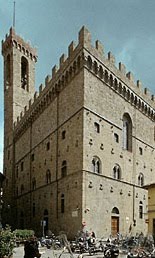
This morning our class visited the Bargello Museum with our "guide" Joan Reifnsyder. It is an incredible museum, often overlooked by many tourists.
Built in the late 1200's, it is one of the oldest public buildings in Florence and eventually became a meeting place for the city council (a guild of merchants). The merchants' power was, however, severely limited by their lack of a military for they were not nobility afterall. For protection, they would hire a knight from outside of Florence. Bargello actually means Captain of Justice and the influence of these "captains" can be seen in their coats of arms lining the interior wall of of the courtyard. By 1574 the building served as a jail and many of the rooms still show evidence of where the cells used to divide the space.
By the mid 1800's, the Bargello became the first national museum as Italy united and Florence was the Capital for a short 5 year stint. At that time it was completely restored, vaults painted etc. and the building appears now as it was completed then. It is primarily a sculpture museum, housing important works by Ghiberti, Brunelleschi, Donatello, and Michelangelo (all of whom are considered Renaissance artists). I name these artists, specifically, because their sculptures are so much better understood within their cultural context.
I, for one, am not a fan of gilded allegorical works. If I had been in the Bargello by myself I would have flown by these two "Sacrifice of Isaac"s without a second thought. But they both play an important role in Florentine architecture and provide interesting insights into newly emerging Renaissance tastes.
by Lorenzo Ghiberti by Filippo Brunelleschi
In 1401 there was a competition to commission an artist to design the doors on the northern entrance to the Florence Baptistry. Several artists competed, all adhering to the same parameters of design (Isaac and Jacob, an angel, a symbolic lamb, a donkey and two shepherds) but only the 1st and 2nd place pieces were saved... the rest were melted down for the bronze to be used in the actual making of the doors... a classic example of how art was actually created in the Renaissance: by commission only. Artists didn't create a piece of art and then try to sell it, like now. Every artist knew exactly where the money was coming from before they started any work of art.
Ghiberti's design won the competition. But why was it chosen over over Brunelleschi's? It all comes down to composition and the depiction of emotion. Ghiberti's design is classically Greek, with the contraposto (weight on one leg with lowered opposite shoulder) pose of Isaac and the beautiful angular structure of the figures, where the eye is led from the symbolic lamb in the upper left, down through Abraham's upraised arm and then perfectly supported at the bottom by the donkey and shepherds. The figures are calm and contained within their borders. Brunelleschi's in much more violent. Abraham is already plunging the knife into Isaac's throat (so much so that the Angel has to actually physically restrain his hand) and the look of torture and anguish on both Isaac and Abraham's face is palpable. The bottom figures seem to be bursting from their borders rather than maintaining a supportive calm. This is the direction the Renaissance will eventually head (Caravaggio immediately comes to my mind) but Florentine tastes are not there yet. They are looking to the ancient Greeks for their aesthetics and so Ghiberti wins because his design is perfectly aligned with such fashions.
When Ghiberti won the competition it began an incredible series of events... later, by default from his success on the northern entrance, he created the famous golden doors of the eastern entrance, coined the "Gates of Paradise" by Michelangelo. AND, Brunelleschi having lost the commission, left Florence to study Architecture in Rome, only to return and build the Duomo's magnificent dome! A perfect reminder that rejection in one place can provide the perfect opportunity for excellence elsewhere.
David sculptures can be seen throughout all of Florence. The story of a young boy defeating a man giant through wit alone was a favorite symbol for the budding republic. These two sculptures were both done by Donatello in the early to mid 1400's.
It is hard to believe that these two depictions of David are by the same artist. The one on the left, cast in bronze, is Donatello's most famous work and was the first freestanding statue (meant to be viewed by walking completely around it) created since antiquity. Notice how young David is depicted here, like a prepubescent boy of perfect proportion, with effeminate features, soft skin and an ethereal expression. In contrast, the one on the right, carved in marble, appears strangely elongated (especially in the neck), with a stronger "male" presence and stance.
The bronze has a history of controversy. Some claim the alluring girlishness of the figure pertains to homosexual practices during the Renaissance, others, that Donatello was simply interpreting the Bible's description of the young lad to an exaggerated dramatic effect... stressing the mind over might allegory. So we know that Donatello had obvious and intentional control of his proportions and emotional impact. So why does his marble depiction of the same character appear so distorted? As I have said before, all Renaissance art was produced on commission, so we must understand the purpose of this sculpture, primarily where it was meant to seen from, in order to understand why the artist choose to create it in such a manner. This David was meant to be fitted into a niche upon the facade of a church where it would be viewed by the public. Limited by the narrowness of the street, the viewpoint would be one of a dramatic upward angle, so in order for the proportions to appear correct, they must be elongated else it would seem as though David had no neck at all. A perfect example of how taking art out of its intended context can completely distort our viewing of it.
Just as the David and Goliath story is a potent symbol for Florentine's social philosophy, so too is Michelangelo's portrait of Brutus an important allegory for political prowess. We all know the story of Brutus aiding in the assassination of Julius Cesar. So how is this important to contemporary Florence?
When the bust was commissioned in 1540, Lorenzo di Medici (not the famous Lorenzo the Magnificent) had recently assassinated his cousin Allessandro di Medici, a direct descendant of the Medici family line who had gained much personal power when he had the Pope declare him Duke. Many attribute the commission of the bust as directly linked to this modern day assassination. Even Michelangelo's rough handling of the hair seems to perfectly depict the texture of Allessandro's mulatto race. The commission would have been a reminder to Florentines of the importance of disposing of powerful despots when that power is self proclaimed and not represented by the republic.
Without this knowledge of the contemporary political climate, I would have walked right by this sculpture, writing it off as yet another simple aesthtic honoring of antiquity. I will never look at art so sparingly again, neglecting to inquire into its purpose, and thereby relying solely upon an aesthetic experience. There's so much more to learn about these pieces. What good is perfect technique if the idea behind it is never understood?
This morning our class visited the Bargello Museum with our "guide" Joan Reifnsyder. It is an incredible museum, often overlooked by many tourists.
Built in the late 1200's, it is one of the oldest public buildings in Florence and eventually became a meeting place for the city council (a guild of merchants). The merchants' power was, however, severely limited by their lack of a military for they were not nobility afterall. For protection, they would hire a knight from outside of Florence. Bargello actually means Captain of Justice and the influence of these "captains" can be seen in their coats of arms lining the interior wall of of the courtyard. By 1574 the building served as a jail and many of the rooms still show evidence of where the cells used to divide the space.
By the mid 1800's, the Bargello became the first national museum as Italy united and Florence was the Capital for a short 5 year stint. At that time it was completely restored, vaults painted etc. and the building appears now as it was completed then. It is primarily a sculpture museum, housing important works by Ghiberti, Brunelleschi, Donatello, and Michelangelo (all of whom are considered Renaissance artists). I name these artists, specifically, because their sculptures are so much better understood within their cultural context.
I, for one, am not a fan of gilded allegorical works. If I had been in the Bargello by myself I would have flown by these two "Sacrifice of Isaac"s without a second thought. But they both play an important role in Florentine architecture and provide interesting insights into newly emerging Renaissance tastes.
by Lorenzo Ghiberti by Filippo Brunelleschi
In 1401 there was a competition to commission an artist to design the doors on the northern entrance to the Florence Baptistry. Several artists competed, all adhering to the same parameters of design (Isaac and Jacob, an angel, a symbolic lamb, a donkey and two shepherds) but only the 1st and 2nd place pieces were saved... the rest were melted down for the bronze to be used in the actual making of the doors... a classic example of how art was actually created in the Renaissance: by commission only. Artists didn't create a piece of art and then try to sell it, like now. Every artist knew exactly where the money was coming from before they started any work of art.
Ghiberti's design won the competition. But why was it chosen over over Brunelleschi's? It all comes down to composition and the depiction of emotion. Ghiberti's design is classically Greek, with the contraposto (weight on one leg with lowered opposite shoulder) pose of Isaac and the beautiful angular structure of the figures, where the eye is led from the symbolic lamb in the upper left, down through Abraham's upraised arm and then perfectly supported at the bottom by the donkey and shepherds. The figures are calm and contained within their borders. Brunelleschi's in much more violent. Abraham is already plunging the knife into Isaac's throat (so much so that the Angel has to actually physically restrain his hand) and the look of torture and anguish on both Isaac and Abraham's face is palpable. The bottom figures seem to be bursting from their borders rather than maintaining a supportive calm. This is the direction the Renaissance will eventually head (Caravaggio immediately comes to my mind) but Florentine tastes are not there yet. They are looking to the ancient Greeks for their aesthetics and so Ghiberti wins because his design is perfectly aligned with such fashions.
When Ghiberti won the competition it began an incredible series of events... later, by default from his success on the northern entrance, he created the famous golden doors of the eastern entrance, coined the "Gates of Paradise" by Michelangelo. AND, Brunelleschi having lost the commission, left Florence to study Architecture in Rome, only to return and build the Duomo's magnificent dome! A perfect reminder that rejection in one place can provide the perfect opportunity for excellence elsewhere.
David sculptures can be seen throughout all of Florence. The story of a young boy defeating a man giant through wit alone was a favorite symbol for the budding republic. These two sculptures were both done by Donatello in the early to mid 1400's.
It is hard to believe that these two depictions of David are by the same artist. The one on the left, cast in bronze, is Donatello's most famous work and was the first freestanding statue (meant to be viewed by walking completely around it) created since antiquity. Notice how young David is depicted here, like a prepubescent boy of perfect proportion, with effeminate features, soft skin and an ethereal expression. In contrast, the one on the right, carved in marble, appears strangely elongated (especially in the neck), with a stronger "male" presence and stance.
The bronze has a history of controversy. Some claim the alluring girlishness of the figure pertains to homosexual practices during the Renaissance, others, that Donatello was simply interpreting the Bible's description of the young lad to an exaggerated dramatic effect... stressing the mind over might allegory. So we know that Donatello had obvious and intentional control of his proportions and emotional impact. So why does his marble depiction of the same character appear so distorted? As I have said before, all Renaissance art was produced on commission, so we must understand the purpose of this sculpture, primarily where it was meant to seen from, in order to understand why the artist choose to create it in such a manner. This David was meant to be fitted into a niche upon the facade of a church where it would be viewed by the public. Limited by the narrowness of the street, the viewpoint would be one of a dramatic upward angle, so in order for the proportions to appear correct, they must be elongated else it would seem as though David had no neck at all. A perfect example of how taking art out of its intended context can completely distort our viewing of it.
Just as the David and Goliath story is a potent symbol for Florentine's social philosophy, so too is Michelangelo's portrait of Brutus an important allegory for political prowess. We all know the story of Brutus aiding in the assassination of Julius Cesar. So how is this important to contemporary Florence?
When the bust was commissioned in 1540, Lorenzo di Medici (not the famous Lorenzo the Magnificent) had recently assassinated his cousin Allessandro di Medici, a direct descendant of the Medici family line who had gained much personal power when he had the Pope declare him Duke. Many attribute the commission of the bust as directly linked to this modern day assassination. Even Michelangelo's rough handling of the hair seems to perfectly depict the texture of Allessandro's mulatto race. The commission would have been a reminder to Florentines of the importance of disposing of powerful despots when that power is self proclaimed and not represented by the republic.
Without this knowledge of the contemporary political climate, I would have walked right by this sculpture, writing it off as yet another simple aesthtic honoring of antiquity. I will never look at art so sparingly again, neglecting to inquire into its purpose, and thereby relying solely upon an aesthetic experience. There's so much more to learn about these pieces. What good is perfect technique if the idea behind it is never understood?
Wednesday, June 30, 2010
A "New" Technique For Accuracy
At the Florence Academy of Art they teach the Sight-Size Method, a technique used in the 15th to 18th Century ateliers that allows artists to capture their subject in the exact size that it appears. Basically you set up your easel at a desired distance (the closer to the model the more life sized it will be) and take several steps back. From this vantage point, where the model and your easel are perceived on the same plane, you can begin to translate your view in a one to one ratio. Many artists use tools, like plumb lines (a piece of string with a weight tied to the end so it hangs perfectly vertical) so they can properly see the proportions of where things lie in relation to eachother. Some even use sticks for measuring and black mirrors to properly gauge shadow and light relationships. Once you have a perfect outline of the form then you can start blocking in shadows.
The process is incredibly tedious, involving an observation from the vantage point (feet squared, back straight, arms locked into the correct position for measuring!), walking up to the paper, placing the mark from memory and then returning to the exact same vantage point to observe again to make sure you made a correct mark. Then returning to your easel to make corrections. Try this back and forth for 3 hours with a live model who inevitably is moving. Just the slightest inch of weight change and your drawing is no longer accurate! Oooof.
Of course all of this painstaking work is only for a prepatory drawing that will then be transferred to canvas so that when the painting process begins all the quarks have been worked out. So it's all about simplicity and clarity of outline and where blocks of shadow fall within the form. You're not making a pretty drawing, just a mechanical rendition for plotting a painting. That has been the hardest part for me to get over.
I've been working from live models for years under a completely different philosophy. In Paris I learned to paint the live figure intuitively, to use every contour line to express the model's interior energy. A hard line that separates form in light and shadow doesn't really exist when the transitions always blur in living movement. Even as a small child I specifically remember the moment when, adhering to coloring within the lines in my cartoon book, I searched in vain for my own outline.
Needless to say the past two days have been intense. The physical exhaustion of standing and walking back and forth from vantage point to easel is compounded a thousandfold by the mental concentration needed for such an exercise. They say master chess players burn 5,000 calories just thinking. I wonder what an artist burns just looking?! I can probably eat all the gelato my heart desires.
Tuesday, June 29, 2010
Paint is Liquid Thought
"Paint records the most delicate gesture and the most tense. It tells whether the painter sat or stood or crouched in front of the canvas. Paint is a cast made of the painter's movements, a portrait of the painter's body and thoughts. The muddy moods of oil paints are the painter's muddy humors, and its brilliant transformations are the painter's unexpected discoveries. Painting is an unspoken and largely unrecognized dialogue, where paint speaks silently in masses and colors and the artists responds in moods. All those meanings are intact in the paintings that hang in museums: they preserve the memory of the tired bodies that made them, the quick jabs, the exhausted truces, the careful nourishing gestures. Painters can sense those motions in the paint even before they notice what the paintings are about. Paint is water and stone, and it is also liquid thought. " ~James Elkins from What Painting Is
Subscribe to:
Posts (Atom)